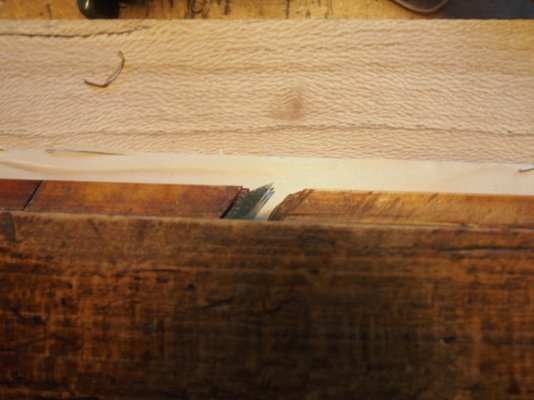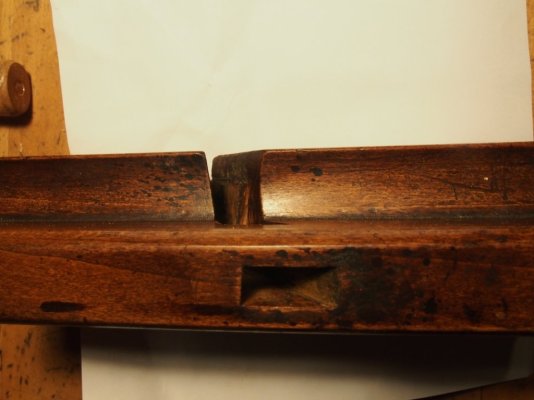

hoi allemaal, een nieuwe ontdekking: ik dacht, laat ik eens de snijhoek, dus de hoek van de kikker met de zool, opmeten. Ik kom op maarliefst 54 graden, ipv de 45 graden waar ik van uit ging. Ik lees ergens:
"Suppose you have a shaving and you start bending it up higher and higher. It's going to break. And a broken shaving has no strength. In the picture above, we have a typical Stanley #3 bevel down plane set at "Common Pitch," which is 45° generally considered a good blade angle for softwoods. Behind it is a Norris wooden plane from the mid-late 19th century. Its bevel down blade is set at "York Pitch," or 50° which is pretty usual for wooden planes and recommended for hardwood. Behind that is a Marples hollow from about 1900. Its blade is set slightly higher to 55° or "Middle Pitch," which is normal for molding planes on softwoods. The trickier the wood, the higher the blade angle goes. These angles are really most appropriate for single iron planes. Planes with a double iron can be at common pitch and work great. On molding planes and other planes where a double iron can't be fitted, the higher angle is important, especially since you can't always choose your grain direction when you are molding an edge.
The tradeoff is the higher the blade angle. The more drastically you are trying to turn and break a shaving, the harder the plane will be to push."
(bron: The Engineering of Thin Plane Shavings - High Angles)
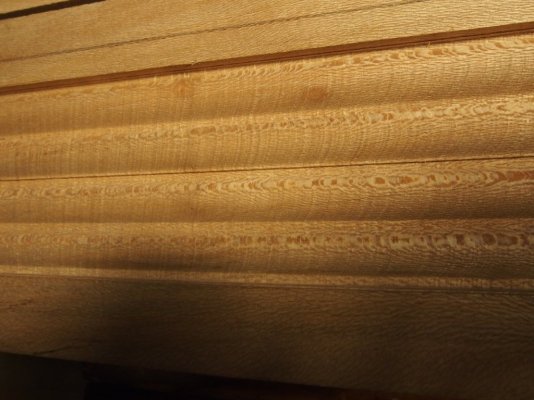
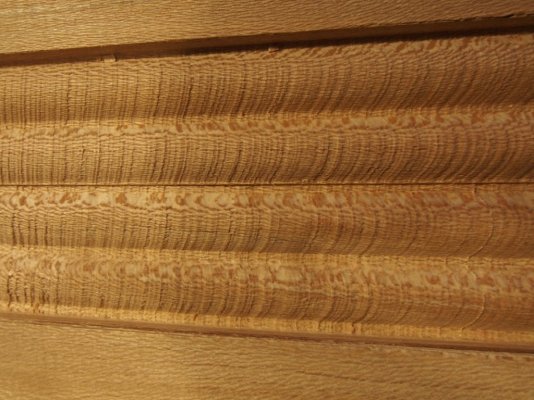
Ik vraag mij nu dus af, of de meer schrapende aktie misschien zo bedoeld is?
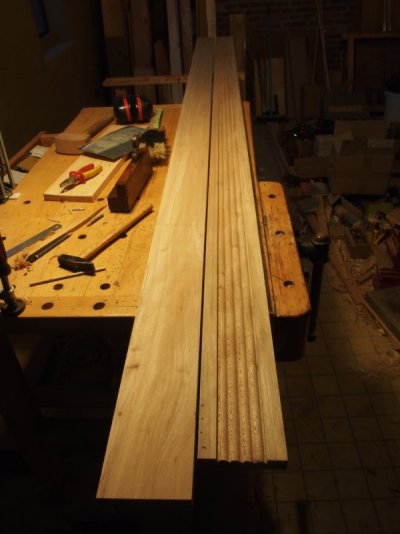
Na het slijpen gaat het wel wat beter: ik kan nu, weliswaar met veel inspanning, redelijk goed een profiel schaven. Ben er al wel even mee bezig, met 250 cm lengte. Hierna nog 3 banen van elk 250 cm en dan ben ik klaar. Ben nu al zo'n uurtje bezig met 1 baan... Last van een koude werkplek bij 12 graden Celcius heb ik trouwens niet!
"Suppose you have a shaving and you start bending it up higher and higher. It's going to break. And a broken shaving has no strength. In the picture above, we have a typical Stanley #3 bevel down plane set at "Common Pitch," which is 45° generally considered a good blade angle for softwoods. Behind it is a Norris wooden plane from the mid-late 19th century. Its bevel down blade is set at "York Pitch," or 50° which is pretty usual for wooden planes and recommended for hardwood. Behind that is a Marples hollow from about 1900. Its blade is set slightly higher to 55° or "Middle Pitch," which is normal for molding planes on softwoods. The trickier the wood, the higher the blade angle goes. These angles are really most appropriate for single iron planes. Planes with a double iron can be at common pitch and work great. On molding planes and other planes where a double iron can't be fitted, the higher angle is important, especially since you can't always choose your grain direction when you are molding an edge.
The tradeoff is the higher the blade angle. The more drastically you are trying to turn and break a shaving, the harder the plane will be to push."
(bron: The Engineering of Thin Plane Shavings - High Angles)
Ik vraag mij nu dus af, of de meer schrapende aktie misschien zo bedoeld is?
Na het slijpen gaat het wel wat beter: ik kan nu, weliswaar met veel inspanning, redelijk goed een profiel schaven. Ben er al wel even mee bezig, met 250 cm lengte. Hierna nog 3 banen van elk 250 cm en dan ben ik klaar. Ben nu al zo'n uurtje bezig met 1 baan... Last van een koude werkplek bij 12 graden Celcius heb ik trouwens niet!
Laatst bewerkt:



 of iets minder grof afstellen ( misschien)